Almost every serious supplier contract has an annex with performance agreements. 99.9% availability. Incidents resolved within four hours. Customer satisfaction of at least 8. On paper it is all well arranged.
And then nothing happens. Nobody measures it, nobody tracks when the target is missed, and the penalty clause procurement negotiated so hard for is never invoked. At renewal, all that's on the table is a gut feeling.
Short answer: agree three to five measurable KPIs per contract, each with a target, a measurement frequency, a source and an owner. Record every measurement, including when all is well. Review the results with the supplier every quarter, claim service credits when targets are missed, and use the measurement history at the next renewal.
SLA and KPI: what's the difference?
- An SLA (service level agreement) is the agreement on the level of service. Often an annex to the main contract, sometimes a separate document.
- A KPI (key performance indicator) is the yardstick that shows whether that level is being met.
The SLA says "incidents are resolved quickly". The KPI says "95% of priority 1 incidents are resolved within four hours, measured monthly based on the supplier's ticketing system". You can monitor the second one; you can't monitor the first.
Examples by contract type
| Contract type | Example KPIs |
|---|---|
| SaaS and hosting | Availability ≥ 99.9% per month; priority 1 response time ≤ 1 hour; planned maintenance announced ≥ 5 working days ahead |
| IT management and support | Priority 1 resolution time ≤ 4 hours; first-time fix ≥ 80%; satisfaction after ticket ≥ 8 |
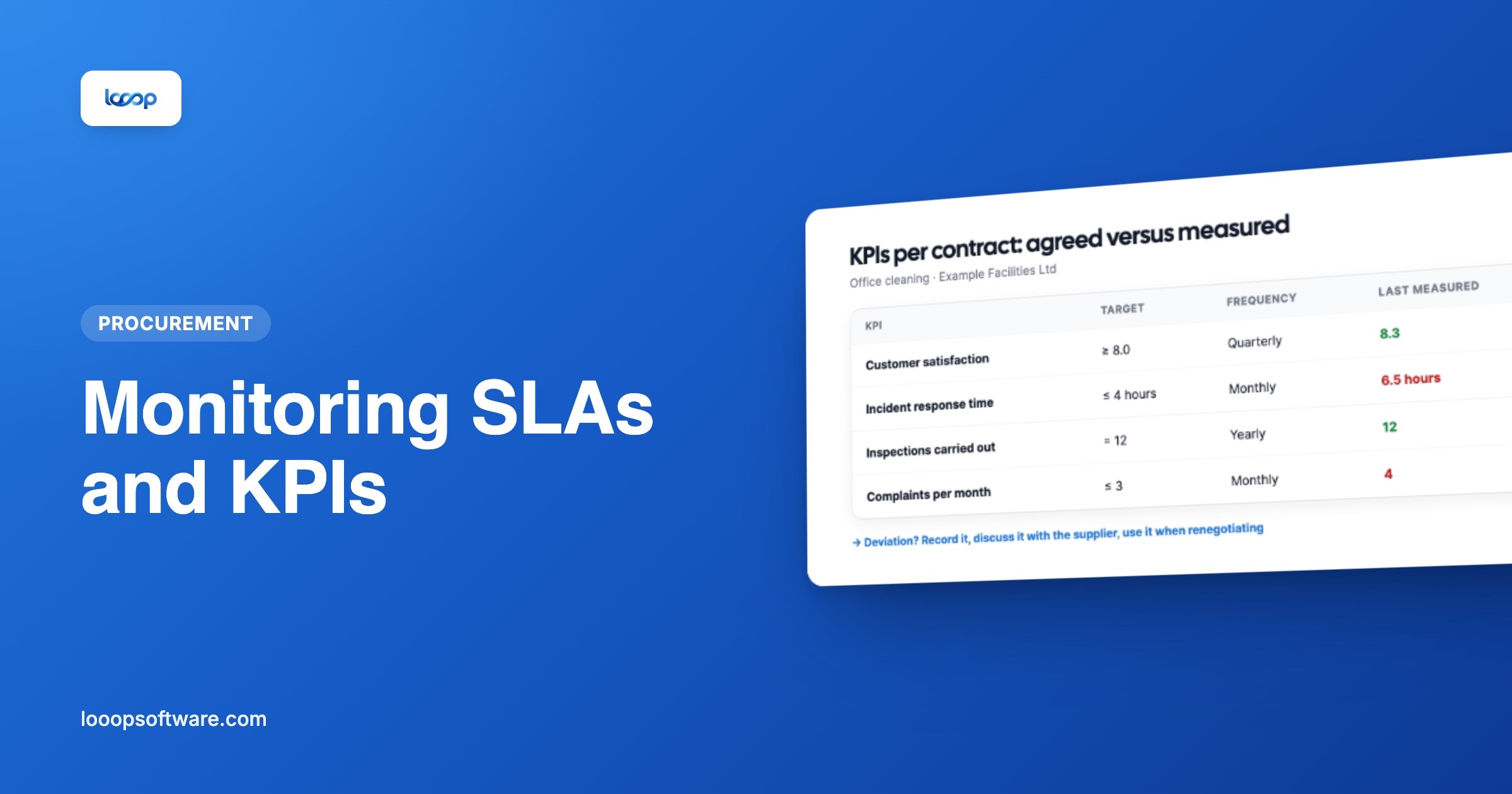
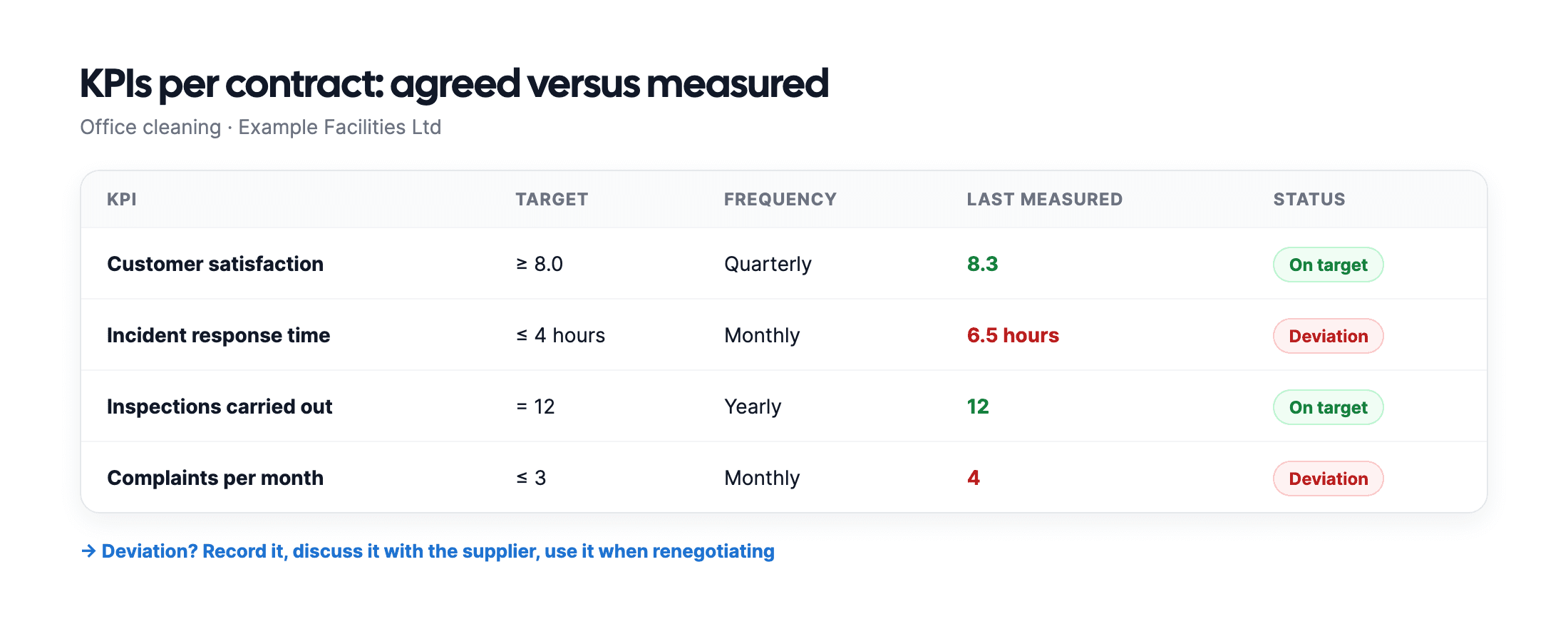
| Cleaning and facilities | Quality score at inspection ≥ 85%; complaints ≤ 3 per month; planned inspections = 12 per year |
| Logistics and delivery | On-time delivery ≥ 98%; incorrect deliveries ≤ 0.5%; damage-free deliveries ≥ 99% |
| Staffing and secondment | Requests filled within 5 working days ≥ 90%; early turnover ≤ 5% |
| Equipment maintenance | Preventive maintenance on schedule = 100%; faults resolved ≤ 24 hours |
Use this as inspiration, not as a standard. The best KPIs are the indicators that hurt your organisation when things go wrong.
A KPI you can actually monitor
A KPI is only usable when five things are fixed:
- What you measure, so concretely that it can't be disputed
- The target, with a direction: minimum, maximum or exact
- The measurement period and frequency: weekly, monthly, quarterly or yearly
- The source: whose system or report is authoritative?
- Who measures and records, on your side and the supplier's
Without an agreed source, every deviation becomes a debate about the numbers rather than the solution. So agree that the supplier reports monthly, and that you spot-check.
The measurement rhythm
Measuring too often is as harmful as not measuring: if it's too much work, it stops after three months. A workable rhythm:
- Monthly for critical services: IT, hosting, logistics.
- Quarterly for most facilities and business services.
- Yearly for commitments such as certifications, insurance and inspections.
Review the results with the supplier at least every quarter, even when all is well. A relationship that runs smoothly is information too, and it makes the conversation easier when something does go wrong.
What to do when a KPI is missed
A missed KPI is no reason to panic, but it does call for a fixed approach:
- Record it, with date, measurement and context. Unrecorded, it won't exist a year from now.
- Discuss it with the supplier and ask for an improvement plan with a deadline.
- Claim service credits if they were agreed. This is often forgotten, even though it is money you are entitled to.
- Escalate if it recurs to the level set out in the contract, up to a formal notice of default.
- Include it in the review before the notice deadline. A supplier that structurally underperforms is a candidate for renegotiation or replacement.
The measurement history is your strongest argument at renewal. "We missed the response time in seven of the last twelve months" negotiates very differently from "we feel it could be better".
KPIs and risks belong together
A supplier that structurally underperforms is also a risk: to your operations, your customers or your compliance. So record that risk too, with a likelihood, an impact and an owner. How to approach that: mapping contract risk.
SLAs and KPIs in Looop
In Looop you record KPIs on the contract itself, in every plan:
- Per KPI a name, unit, target with a direction (minimum, maximum or exact) and a measurement frequency: weekly, monthly, quarterly or yearly.
- Measurement tasks are scheduled automatically. Record a measurement and Looop schedules the next one straight away on your task board.
- Every measurement gets a status: on target or deviation. So you see at a glance which suppliers are underperforming.
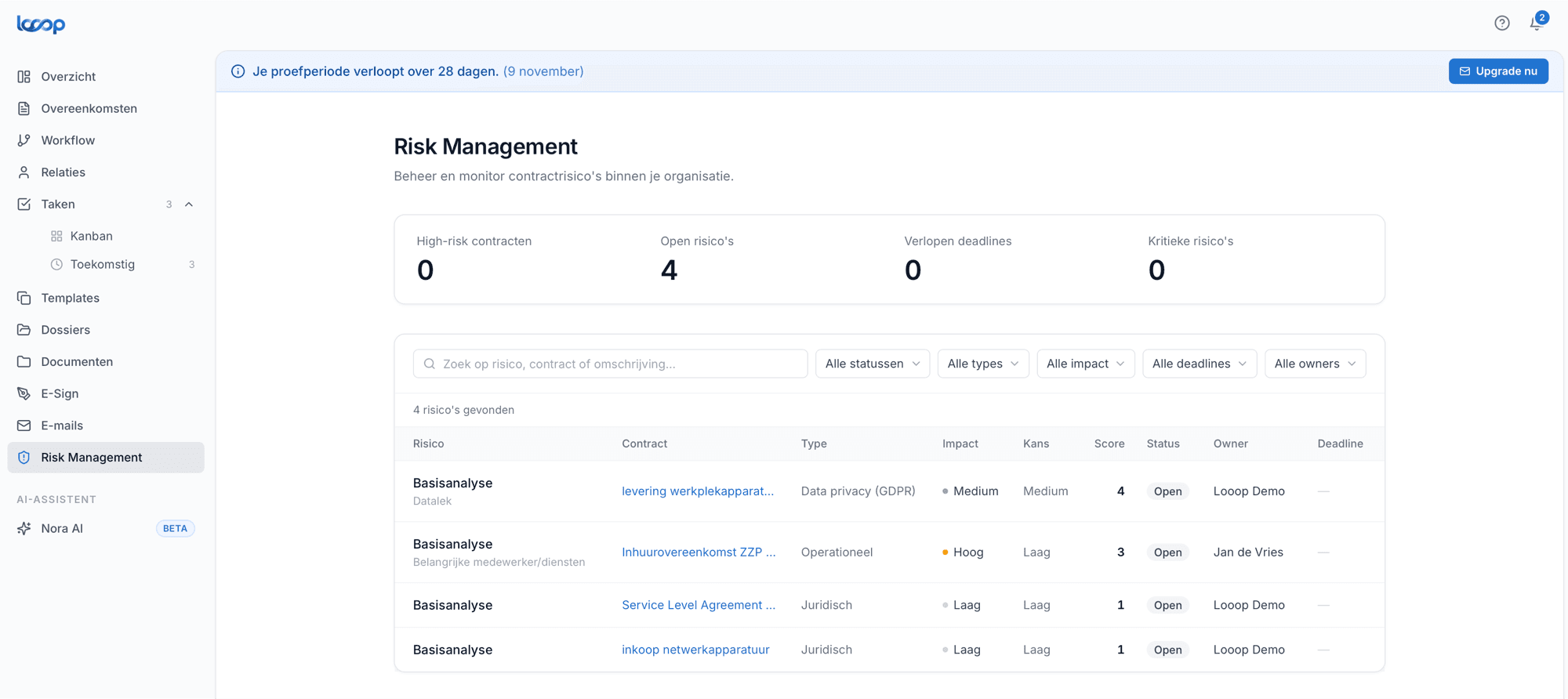
- Risk management on the same contract, so a structural deviation can be recorded as a risk right away.
- Expiry alerts 90, 60, 30 and 7 days before the notice deadline, so you have the measurement history on the table in time.
Working in procurement? Also see our page for procurement teams.
Frequently asked questions
- What is the difference between an SLA and a KPI?
- An SLA (service level agreement) is the agreement on the level of service, often an annex to a contract. A KPI is a measurable indicator that shows whether that level is being met, for example availability of at least 99.9% or a response time of at most four hours.
- How many KPIs should you agree per contract?
- Three to five is enough. Pick the indicators that really matter to your operations. More KPIs means more measuring, and in practice they then stop being measured.
- What are service credits?
- Service credits are a refund or discount you receive when the supplier misses an agreed service level. They are often in the SLA but rarely claimed, because nobody tracks when the target was missed.
- How often should you measure KPIs?
- Match the frequency to the risk: critical IT services monthly, facilities services quarterly, and annual commitments such as inspections or certifications once a year. Review the results with the supplier at least every quarter.