Every software investment needs a business case. For contract management software it is often surprisingly strong, but rarely made concrete. Many articles throw around percentages from international studies that say little about your organisation.
We do it differently. In this article you calculate with your own numbers, using assumptions you can see and adjust.
Short answer: the return on contract management software comes from four items: avoided unwanted renewals, time saved, better renegotiations and reduced risk. The first two are easy to calculate and usually make the business case on their own. In our worked example (80 contracts, three people working with them) that adds up to over €18,000 a year, against around €3,600 in licence costs.
Why the ROI is hard to see
The cost of poor contract management rarely appears on an invoice. It sits in:
- a renewal nobody consciously chose;
- the hours someone spends searching, retyping and chasing signatures;
- a price increase nobody checked;
- a penalty clause you never invoked.
Because those costs are scattered and invisible, the software licence feels like the only real expense. The trick is to make the hidden side visible.
Step 1: avoided unwanted renewals
This is the most concrete item, and often the largest.
Find the contracts in your portfolio that renew automatically: software licences, maintenance contracts, cleaning, telecoms, leases. Then ask how many of them renewed last year without anyone consciously deciding that was the plan.
Calculation: number of unwanted renewals per year × average annual value of those contracts.
It's not only about contracts you wanted to cancel altogether. A renewal where you could have renegotiated, but were too late, counts too.
Not sure? Calculate with one avoided renewal per year. For most organisations with dozens of contracts, that is on the conservative side.
Step 2: time saved
The second item is time. Think of:
- searching for contracts when someone has a question;
- retyping data from PDFs into a spreadsheet;
- setting and maintaining reminders in calendars;
- sending emails to get a signature or approval moving;
- gathering information for the auditor or an audit.
Calculation: number of people × hours per week on contract admin × saving percentage × 48 working weeks × hourly rate.
For the saving percentage, our own ROI calculator uses 30%. That is deliberately conservative. Automatic alerts, AI that reads contracts and e-signing often remove more time in practice, but your business case should hold up if things turn out worse.
Step 3: better renegotiation and indexation
With a complete overview of what you pay each supplier and when contracts expire, you negotiate differently. You start on time, you can compare quotes and you know your total spend with that supplier.
Then there is indexation. Suppliers index their prices every year, sometimes with a different index than the contract states, or on the wrong base. If nobody checks, you pay too much.
Calculation: only include this if you have a concrete example. Otherwise keep it in your business case as an "unquantified additional benefit". That makes the rest of your calculation more credible.
Step 4: reduced risk
A missing data processing agreement, a missed deadline in an SLA or a contract signed by the wrong person: the costs are real, but hard to quantify in advance.
The same applies here: mention it, but don't calculate with it unless you have a concrete past incident. A business case that only works thanks to a hypothetical dispute won't get past a critical CFO.
Worked example
Take an organisation with 80 active contracts. Three people (procurement, finance and office management) each spend around four hours a week on contract admin, at an average internal hourly rate of €60.
| Item | Calculation | Per year |
|---|---|---|
| Avoided renewals | 1 contract worth €8,000 a year | €8,000 |
| Time saved | 3 people × 4 hours × 30% × 48 weeks × €60 | €10,368 |
| Renegotiation and indexation | Not quantified | n/a |
| Reduced risk | Not quantified | n/a |
| Total return | €18,368 | |
| Cost of Looop | Business plan, from €299 a month | €3,588 |
| Net return | €14,780 |
So every euro of licence fee returns more than five, and the investment pays for itself in just over two months. Looop is available from €59 a month; for a team of three a Business plan is the more likely fit, so that is what we use here.
Sensitivity analysis: what if it disappoints?
A good business case shows what happens if the assumptions don't hold.
- Only the avoided renewal, no time saved: €8,000 return against €3,588 cost. Still more than twice the cost.
- Only time saved, no avoided renewal at all: €10,368 return. Almost three times the cost.
- 15% time saving instead of 30%: €5,184 in time plus €8,000 from the renewal, so €13,184. Still more than three times the cost.
The conclusion doesn't change: the biggest risk of this investment is putting it off.
Fill it in with your own numbers
| Question | Your estimate |
|---|---|
| How many active contracts do you have? | ___ |
| How many of them renew automatically? | ___ |
| How many unwanted renewals were there last year? | ___ |
| What is the average annual value of those contracts? | €___ |
| How many people work with contracts? | ___ |
| How many hours a week do they spend on it together? | ___ |
| What is the average internal hourly rate? | €___ |
Rather not do the maths yourself? Enter your figures in our ROI calculator. You'll also find a contract checklist there covering eleven categories, from leases to data processing agreements, in case you don't know how many contracts you have.
Include the costs honestly
A business case is only complete when the costs are complete too. Include:
- Licence costs over three years, not just the first year.
- Implementation and migration, if not included in the price.
- Separate fees for e-signing, AI usage or extra users.
- Internal time for the initial inventory. Allow a few days for the first fifty contracts, less if AI extracts the data from the PDFs.
How prices compare between vendors is covered in what does contract management software cost?.
From calculation to decision
A business case for the board doesn't need to be ten pages. These five parts are enough:
- The problem in one sentence, with a concrete example from the past year
- The return from avoided renewals and time saved, with visible assumptions
- The unquantified benefits: renegotiation, indexation, risk
- The total cost over three years
- A sensitivity analysis: what if it delivers half?
When does it pay back fastest?
Contract management software pays for itself fastest when:
- you have more than around 25 active contracts;
- some of them renew automatically;
- several people are involved in contracts;
- you regularly have contracts signed by external parties.
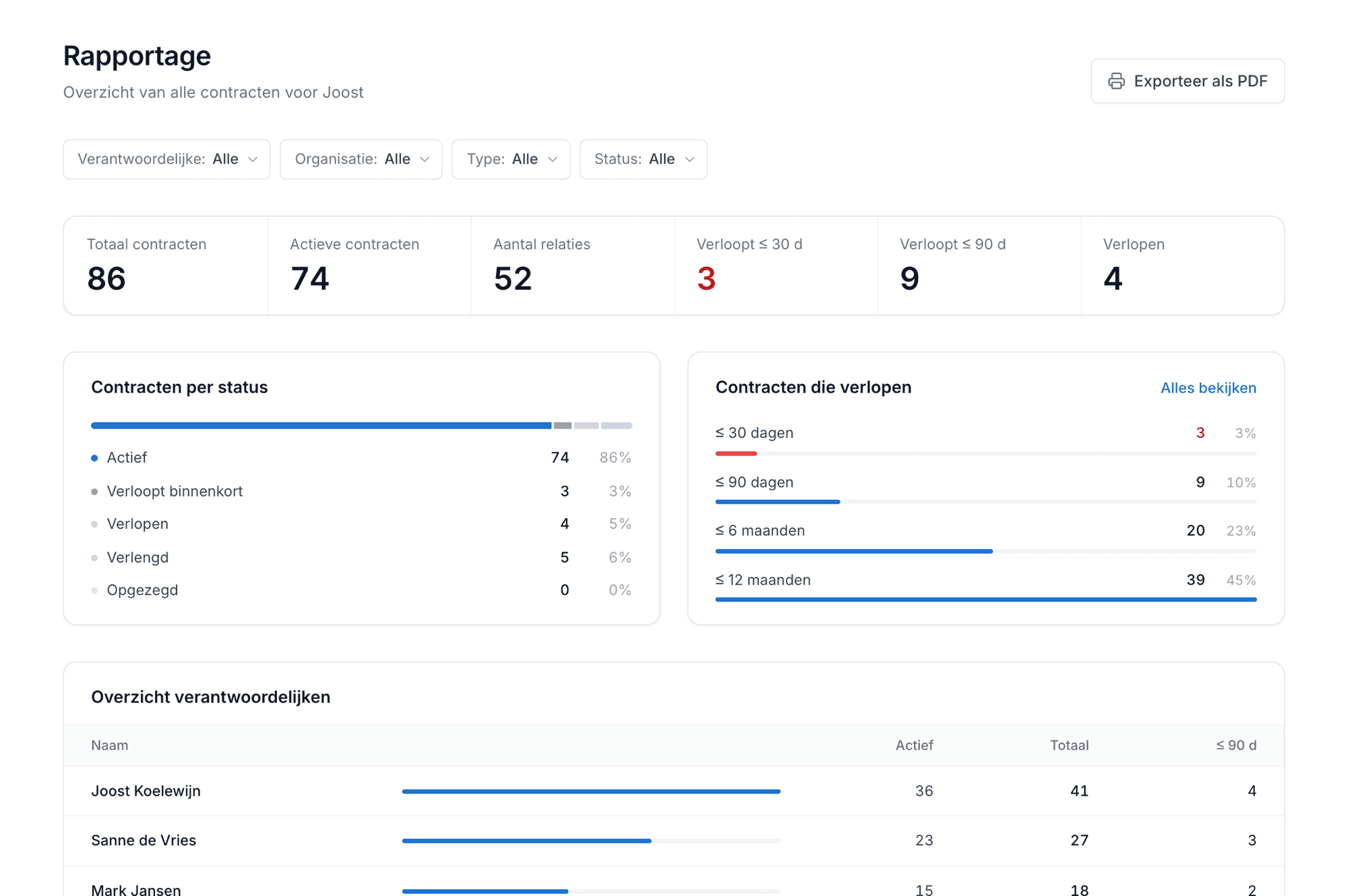
Sound familiar? See how Looop takes over the manual work: expiry alerts 90, 60, 30 and 7 days before the notice deadline to the right owner, NORA AI reading contracts on upload, and e-signing in every plan.
Frequently asked questions
- How do you calculate the ROI of contract management software?
- Add up the annual return from four items: avoided unwanted renewals, time saved, better renegotiations and reduced risk. Subtract the annual software cost and divide by that cost. Be conservative: the first two items are usually enough for a business case that holds up.
- How quickly does contract management software pay for itself?
- It depends on your contract portfolio. Avoiding a single auto-renewal of a contract worth a few thousand euros a year is often enough to pay back an annual SME subscription. In our worked example with 80 contracts, the payback period is just over two months.
- Which costs should the business case include?
- Licence costs over several years, any implementation and migration costs, extra users, separate fees for e-signing or AI, and the internal time for the initial inventory. That last one is the most often forgotten.
- What if I don't know how many contracts we have?
- Start with your accounts: every recurring payment is a contract. The contract checklist on our ROI calculator page goes through eleven categories, from leases to data processing agreements, and helps you get to an estimate quickly.