For most departments, a contract is an agreement. For finance it is something else: an expense that is already locked in, months or years before the invoice arrives.
That makes contract management for finance not an administrative side issue, but the source of some of the most important numbers you have: what is already committed for the coming years, what can you still influence, and what is about to land on your desk unexpectedly?
Short answer: finance needs five things from every contract: the annual and total value, the term with the notice deadline, the renewal and indexation terms, the cost centre, and who approved it. With those you can underpin the budget, report commitments in the annual accounts, and see well in advance which costs you can still influence.
Four reasons finance needs to know the contracts
1. Budget and forecast. A large share of fixed costs is locked into contracts: rent, leases, licences, maintenance, facilities. If you know the contracts, you budget those lines based on agreements rather than last year plus a percentage.
2. Costs you can still influence. Next year's budget is only truly open before the notice deadlines of the contracts. After that, it's fixed. A list of which contracts can be terminated in the next twelve months is one of the most useful lists for any budget round.
3. Commitments in the annual accounts. Running lease, rental and supplier contracts are commitments not yet on the balance sheet. Most reporting frameworks require significant ones to be disclosed in the notes; under IFRS 16, leases even come onto the balance sheet. Check with your auditor what applies to you.
4. Control and authority. Who was allowed to enter into this contract, and up to what amount? For internal control and the auditor, you want to be able to show that contracts were signed within authority.
Which data does finance need?
| Data | What for |
|---|---|
| Annual and total contract value | Budget, commitments overview, prioritising |
| Term, renewal terms and notice deadline | Knowing until when costs can be influenced |
| Indexation clause and indexation date | Predicting and checking cost increases |
| Cost centre, department or entity | Allocating to the right budget holder |
| Payment rhythm (monthly, quarterly, annually in advance) | Cash-flow planning |
| Who approved and signed | Internal control, auditor |
| The document itself | Evidence for questions and audits |
Indexation: the silent cost driver
Most multi-year contracts have an indexation clause. In years of high inflation they add up quickly, and they often arrive unannounced: the supplier sends a letter, or simply adjusts the invoice.
Two things help:
- Include indexation in the budget, based on the clause and an expected index, rather than booking it as a setback.
- Check every indexation against the clause: the right index, the right base, the right date.
Auto-renewal is a budget decision
Every auto-renewal is effectively a budget decision nobody made consciously. That is why the overview of upcoming notice deadlines belongs in the budget cycle:
- Three to six months before the budget, a list of all contracts that can be terminated or renewed in the new year.
- A decision per contract from the budget holder: renew, renegotiate or terminate.
- Process the decision in the budget, and start the termination or renegotiation in time.
Authority and signing rights
A contract signed outside someone's authority is a problem for internal control, and sometimes legally too. So record:
- who may commit to which amount, for example by annual or total value;
- which approvals are needed before signing, for example finance for anything above a set amount;
- that the approval can be proven, with date and name, and kept with the contract.
How to set up such an approval route without slowing the process down: setting up approval workflows for contracts.
Year-end close
At year-end, the auditor usually asks for an overview of running contracts and commitments, and for evidence behind large items. With a maintained contract register, that is an export rather than a search:
- Overview of all running contracts with annual value and remaining term
- Commitments by category: rental, lease, suppliers, licences
- The signed documents for the largest contracts
- Who approved and signed which contract
- Contracts entered into, renewed or ended during the financial year
Ownership: finance oversees, the budget holder decides
Finance doesn't need to manage every contract itself. A workable split:
- The budget holder owns the contract: knows whether it is still needed and decides on renewal or termination.
- Finance oversees the whole: is everything registered, are the values right, was it signed within authority, and do the notice deadlines reach the budget cycle in time?
Contract management for finance in Looop
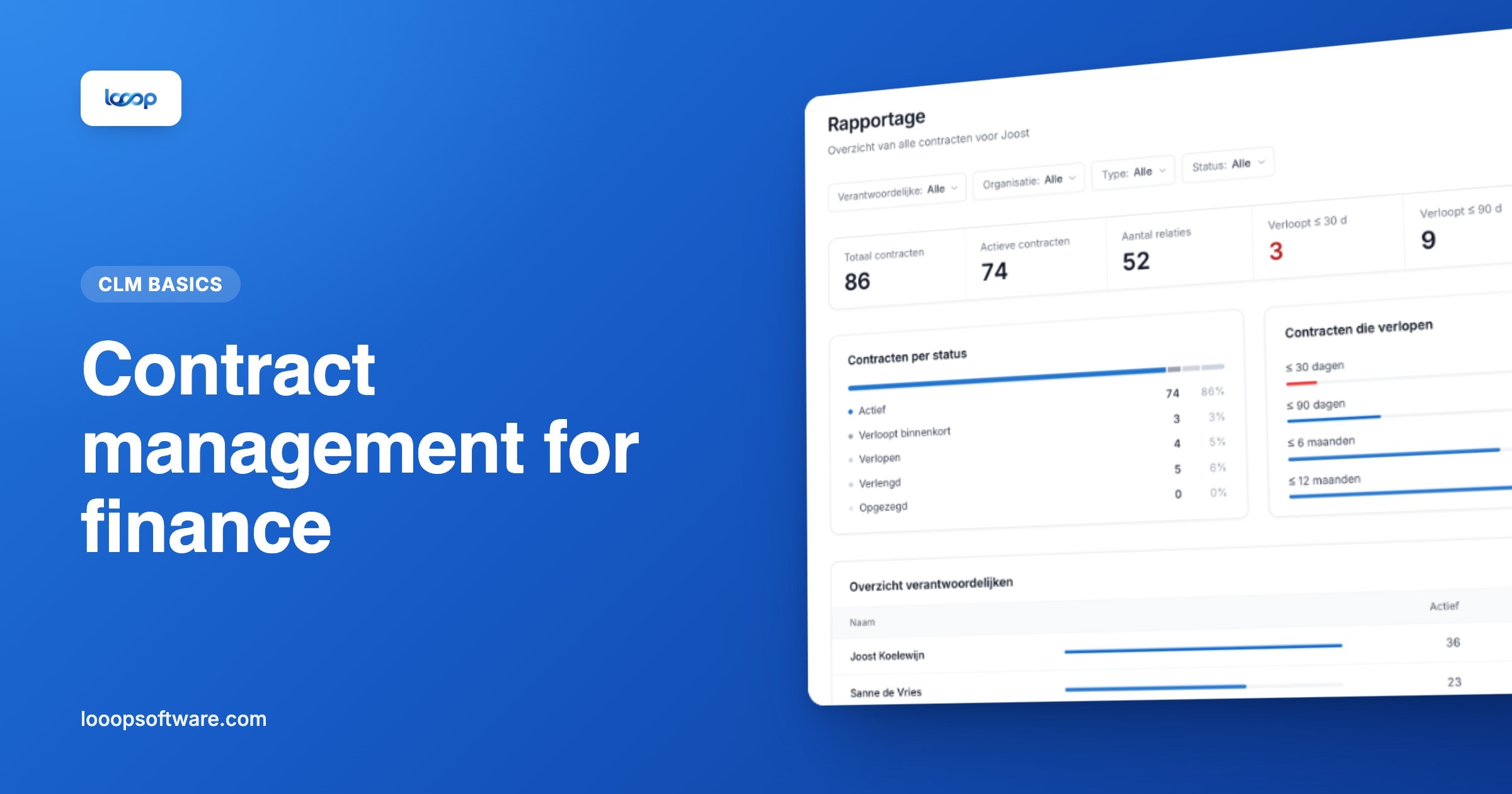
Looop gives finance the overview without anyone maintaining spreadsheets:
- Annual and total value per contract, linked to counterparty, department and owner.
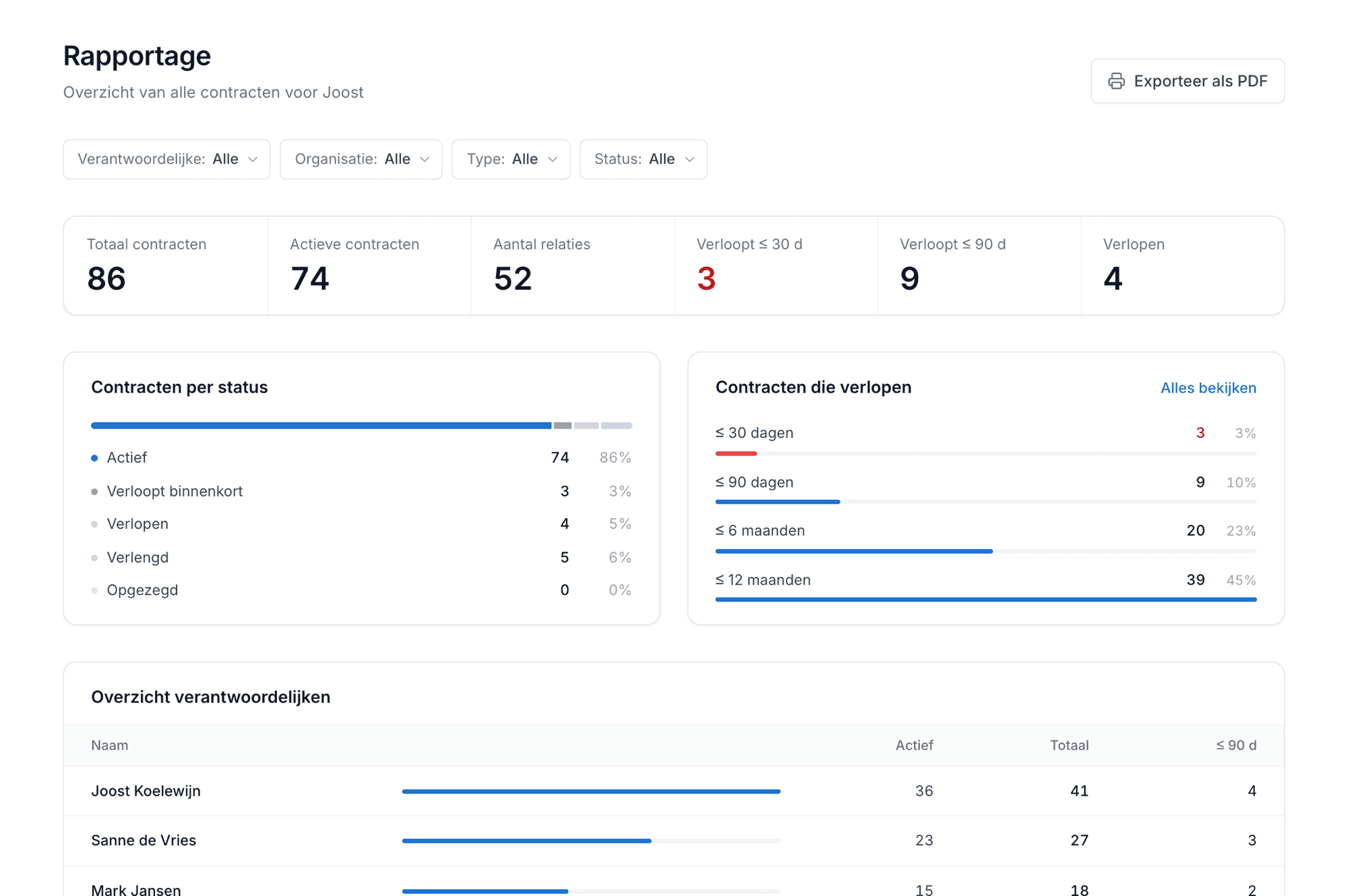
- Reporting and exports across the portfolio: counts per status, what expires in the coming period, and where the value sits.
- Expiry alerts 90, 60, 30 and 7 days before the notice deadline to the budget holder, so the decision reaches the budget cycle in time. You record the indexation date on the contract and check each indexation in time with a task on a fixed date.
- Approval workflows and e-signing with a full audit trail: who approved what, and when.
- Entity management (Enterprise) for organisations with several legal entities.
What contract management delivers financially: the ROI of contract management software in four steps.
Frequently asked questions
- Why does contract management matter to finance?
- Because every contract is an expense that is locked in before the invoice arrives. If you know the contracts, you know future costs: for the budget, cash-flow planning and the notes to the annual accounts. Without an overview, finance only discovers commitments when the invoice comes in.
- What are off-balance-sheet commitments?
- Financial commitments not yet recognised as liabilities, such as running lease, rental and supplier contracts for the coming years. Most reporting frameworks require significant commitments of this kind to be disclosed in the notes to the accounts; check with your auditor what applies to your organisation.
- Which contract data does finance need?
- For each contract: the annual and total value, term and notice period, renewal terms, the indexation clause, the cost centre or department, and who was authorised to enter into it. With that you can budget, report commitments and explain variances.
- Who should own a contract: finance or the budget holder?
- The budget holder. They know whether the contract is still needed and decide on renewal or termination. Finance oversees the process and the overall picture: are all contracts registered, are the commitments known, and was everything signed within authority?