The biggest hurdle in building a contract register is not the software. It is the stack of PDFs someone has to read through to pull out terms, counterparties and notice periods.
At two hundred contracts and a quarter of an hour each, you are fifty hours in. That is exactly the work AI is good at: many documents, recognisable patterns, and a human checking the result.
What AI pulls out of a contract
The data you need to monitor a contract usually comes down to a handful of fields:
| Field | How well this works | Why |
|---|---|---|
| Counterparty | Good | Usually at the top, in standard phrasing |
| Start date | Good | Stated explicitly or derived from signing |
| End date | Reasonable | Sometimes a date, sometimes "twelve months after commencement" |
| Notice period | Variable | Often in the general terms, not the contract |
| Contract value | Variable | Sometimes monthly, sometimes annual, sometimes per unit |
| Renewal clause | Difficult | Buried in running text |
The first three are reliable enough to propose. The bottom three always need a human check.
Be careful with vendors promising their AI processes contracts "fully automatically". For the fields that matter most (notice period and renewal), the information often is not in the contract itself but in a separate document it merely refers to.
Why a suggestion differs from a filled field
The difference between useful and risky AI in contract management comes down to one choice: does the system fill the fields, or propose them?
Filling is faster, but you do not know what was taken over. If a wrong end date turns up later, you have no idea where it came from.
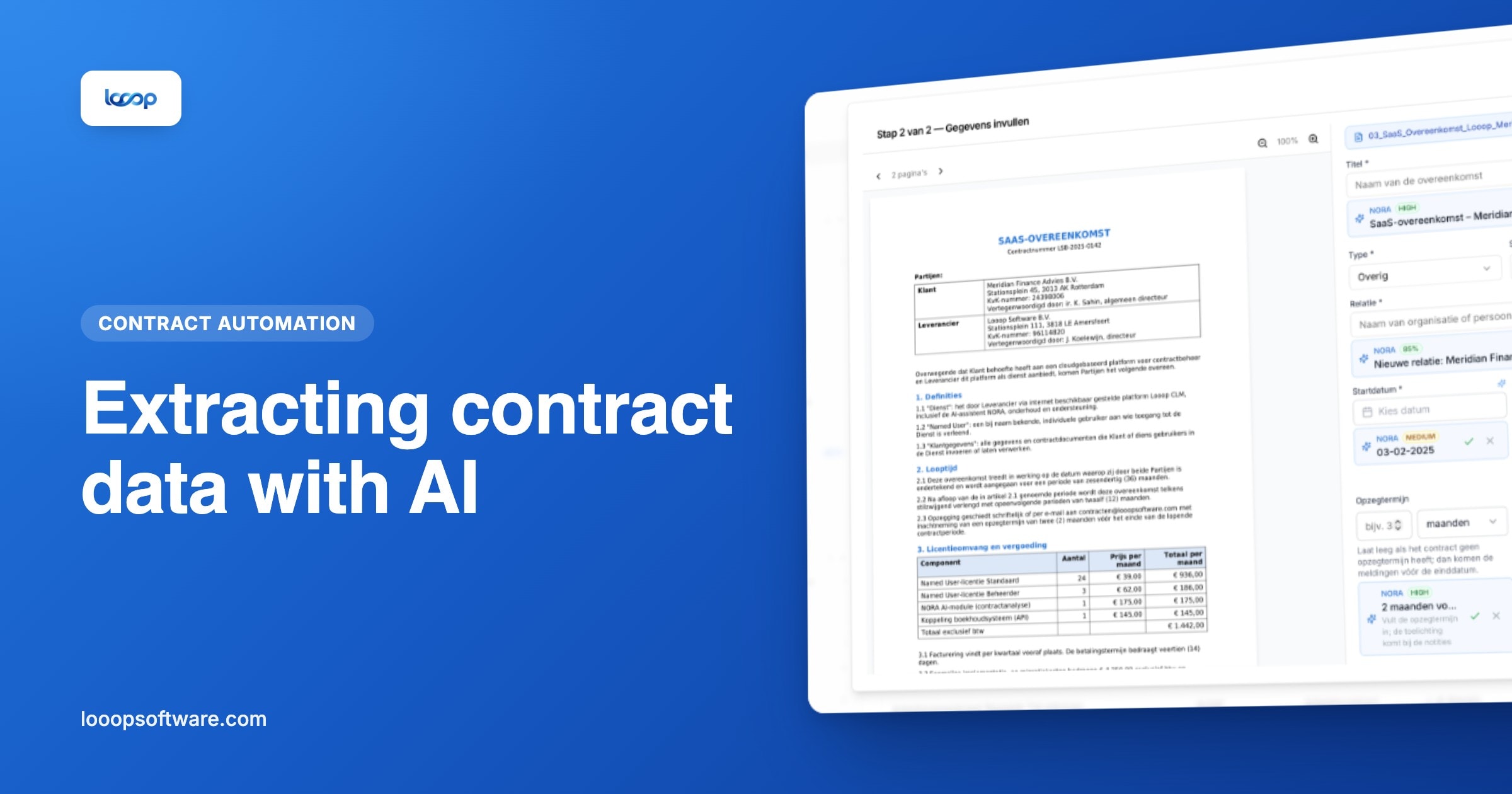
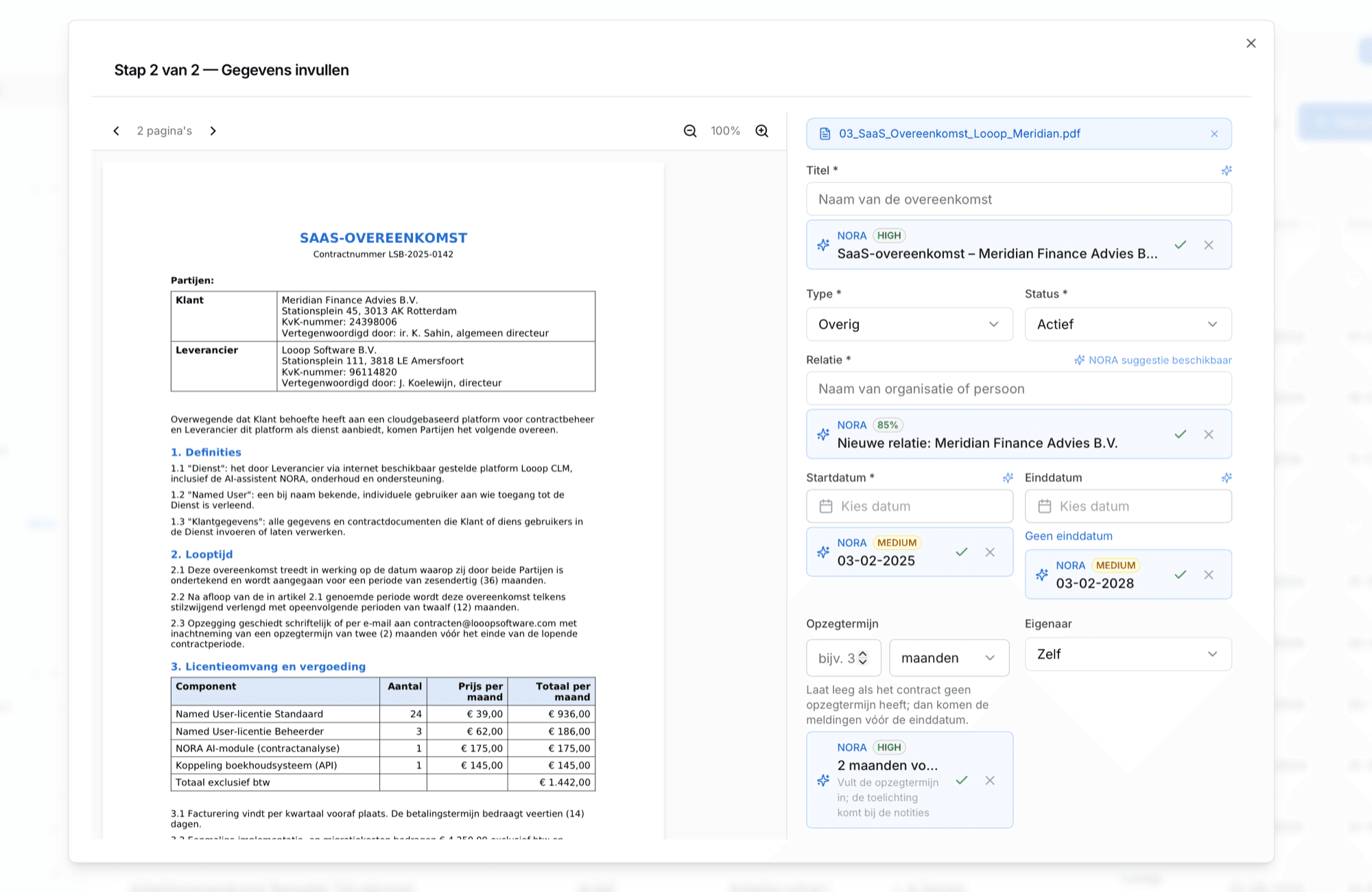
Proposing with a source reference is slower for the user, but verifiable: you can see which suggestion maps to which passage in the document, and accept or reject it at a glance.
In Looop, NORA works the second way. On upload it reads the document, identifies the counterparty and proposes start, end and notice dates, each with a quotation from the document. When the model is unsure, it offers several candidates rather than a single guess.
Where it goes wrong, and how to catch it
Scanned documents. A scanned PDF without a text layer is an image to a model. Text recognition helps, but on poor scans it introduces errors in exactly the numbers and dates you need.
References to other documents. "Our general terms and conditions apply to this agreement": the notice period then sits elsewhere. No model can read a document it does not have.
Your own organisation as the counterparty. A naive model sometimes proposes your own company name, because it also appears at the top of the contract. A system that knows which organisation it works for rules that out.
Amounts without a unit. "€2,500" can be monthly, quarterly or annual. That distinction is a factor of twelve in your reporting.
A workable approach to building your register
- Start with your largest or riskiest contracts, not the oldest
- Let AI do the first pass and check the proposed dates per contract
- Always verify the notice period by hand, even when a suggestion is offered
- When general terms are referenced, find that document too
- Record the contract value with its unit: per month or per year
- Assign an owner immediately, because no model can determine that for you
That last point matters most. AI extracts data from a document. Who is responsible for that contract is not in it, and is precisely the information your monitoring depends on.
What it delivers
Realistically, AI removes most of the data entry, not all of it. Expect a check of two to three minutes per contract instead of a quarter of an hour of reading. At two hundred contracts, that still saves over forty hours.
More important than the time saved is that the barrier disappears. A register that costs fifty hours of manual work does not get built. One that costs ten hours does.
To work out what better grip on your contracts is worth for your organisation, use the ROI calculator.
AI afterwards: asking questions about your portfolio
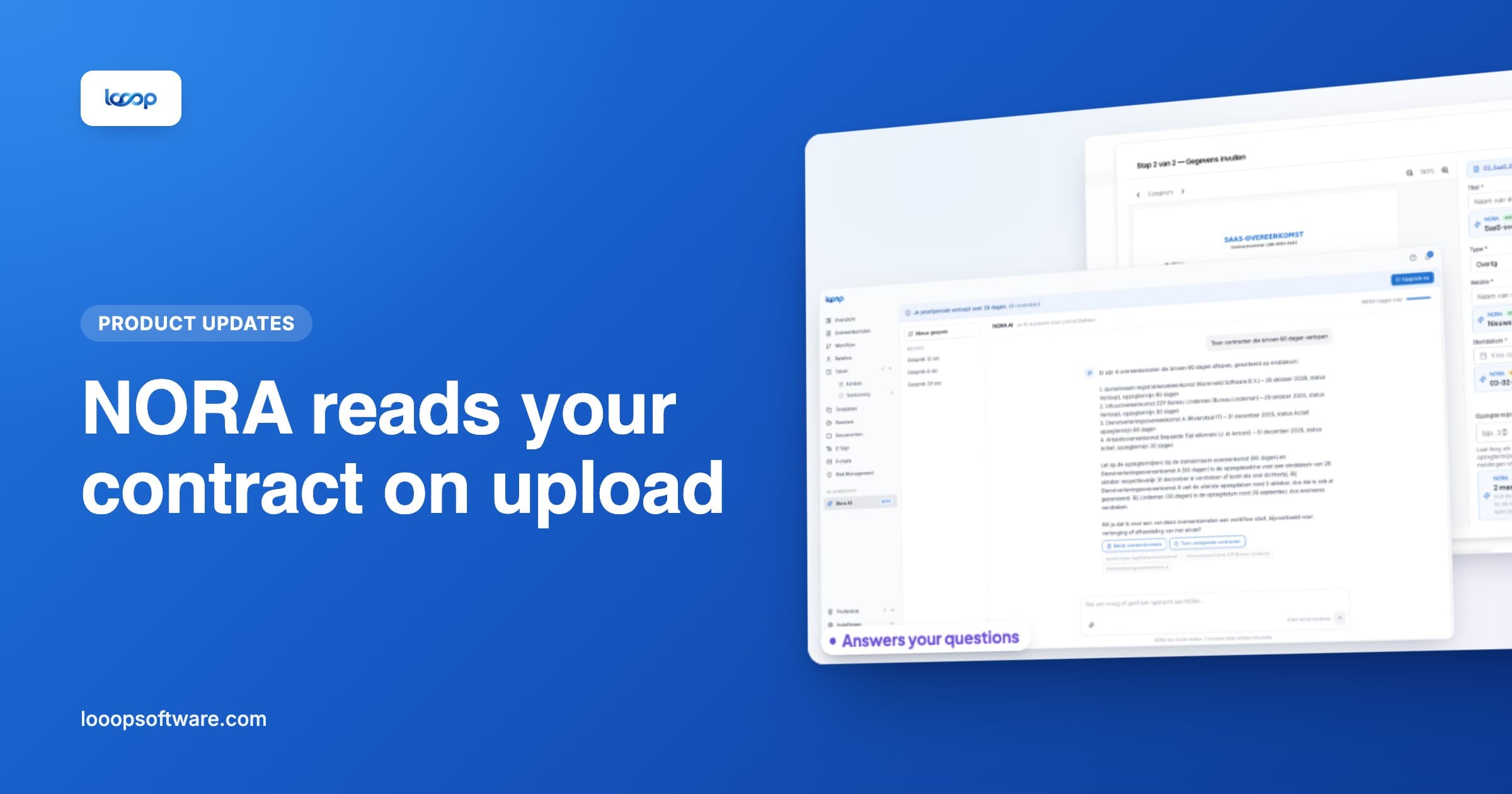
Once the register exists, the value of AI shifts. It is no longer about extraction but about retrieval: "which contracts expire next quarter", "which suppliers are we above a hundred thousand with".
That only works reliably when the underlying data is correct. A model that starts calculating on incomplete data will give a confident wrong answer. That is why NORA takes such figures from fixed, verifiable queries and uses the language model only to phrase the answer.
Further reading
Frequently asked questions
- Which data can AI extract from a contract?
- Counterparty, start date and end date usually work well. Notice period, contract value and renewal clauses are less reliable, because they often sit in the general terms or are stated without a unit. Always check those yourself.
- Should AI fill in contract data or suggest it?
- Suggest it, with a source reference. Then you see which passage a suggestion is based on and accept or correct it at a glance. A system that fills fields silently is faster, but later you won't know where a wrong date came from.
- How much time does AI save when building a contract register?
- Expect two to three minutes of checking per contract instead of fifteen minutes of reading. For two hundred contracts, that saves over forty hours.